Back in late March, I ran a funding round for building Composer Forge - the platform I always dreamed of but never existed. Some place to learn everything about how to be a composer, or not even that, just learn the art of composition, covering all areas.
Music composition is so different from many other arts. You can't just pick up a pencil or a brush, or just buy an instrument and get to it, there is just too much to learn. Should you start with theory? How much theory do you need before you can compose something simple? What about if you don't care about classical or jazz? What about the technical stuff - DAWs? How to make that sound good? What's the best way to go about all this? It's all a bit overwhelming.
I ended up breaking it all down into 5 areas. The story was funny - I was already thinking of how to structure everything, I had looked up countless curriculums from universities and other courses online. I had carried out a survey with this audience right here within Udemy to figure out what the challenges were.
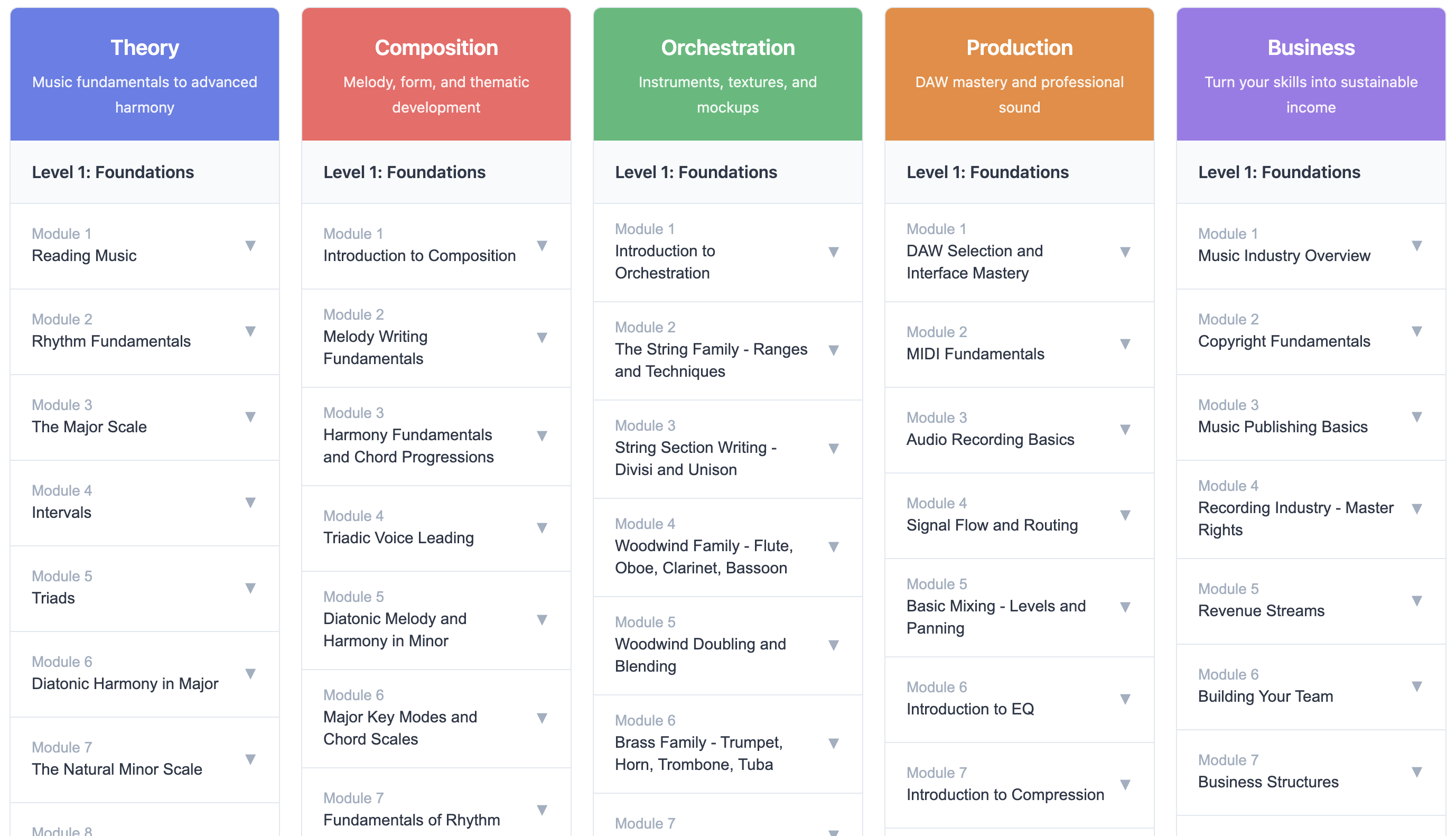
The 5-track system
And the image came to me, whilst I was watching a gig in Scotland. I saw the 5 lines of the equaliser in my mind, and it just made sense all at once. To me, theory made sense as the basis. Of course, you don't need everything required in Theory, but the theory track should be there, the entirety of it, in case you did want to master it.
Next, Composition had to be the backbone. Composition I had found was the worst taught of the lot (besides music business). It's just a bit abstract, there really aren't great programs online purely on composition. For Orchestration, that would definitely be a step above composition. And reading music was kind of necessary by now (covered in Theory track). Orchestration is covered a bit better online - my courses, and others, there are good textbooks and so on.
Production was covered alright usually in EDM and other specialist modules. Business though? Usually that isn't really covered in a general composition degree. And only 33% of people were actually interested in making money from composition anyway, according to my survey.
And that's how it all came together. The tracks don't have to be taken strictly in that order, but in general that was the difficulty, left to right from beginner to advanced. And once you had enough Theory, you could start Composition, or once you had enough Theory and Composition, you could begin Orchestration, you don't have to be super strict about finishing one track first - it'll probably be more boring that way.
This is the 5-track system:
What's live now
By late May, I had released the beginnings of the Theory track and the Composition track. I found some super good instructors that explain well, have passion, and just have a similar vibe to mine, as I know students enjoyed the way I would teach.
This is still progressing nicely and according to plan, but I came up with another idea in June - that introducing a live component might make things more enjoyable and worthwhile, for people that find the self-paced nature of online courses lonely. It can be difficult to motivate yourself without others there or being forced through it.
The live program
And this is why Composer Forge now has its own Live Program. Composition 1 Foundations, covering Modules 1-12 of the Composition track, one module per week. The program starts in early August, and is a very good mix of theory and practical. Right now, since it's the first ever live program, there's a way to get it essentially free - if you turn up for all the sessions and do all the exercises, you get the entire price back.
You will also get immediate access to Level 1 of the Theory and Composition tracks, which are currently being built.